Most specific facts about Spotted Hyenas in Africa
Some Facts About Spotted Hyenas
The spotted hyena (Crocuta crocuta), also known as the laughing hyena, is a species of hyena, currently classed as the sole member of the genus Crocuta, native to sub-Saharan Africa. It is listed as being of least concern by the IUCN on account of its widespread range and large numbers estimated between 27000 and 47000 individuals.
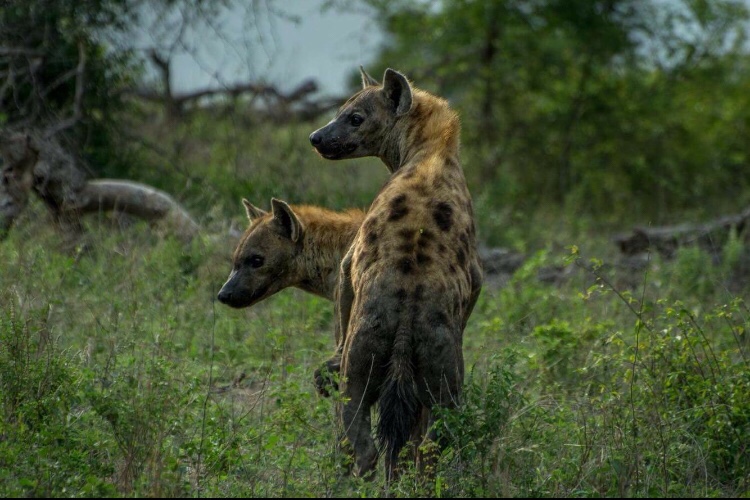
The species is, however, experiencing declines outside of protected areas due to habitat loss and poaching. The spotted hyena is the most social of the carnivora in that it has the largest group sizes and the most complex social behaviours. Its social organisation is unlike that of any other carnivore, bearing closer resemblance to that of some primates (baboons, monkeys, etc) with respect to group size, hierarchical structure, and frequency of social interaction among both kin and unrelated group-mates. The spotted hyena is a highly successful animal, being the most common large carnivore in Africa. Its success is due in part to its capacity to eat and digest skin, bone, and other animal waste.
In functional terms, the spotted hyena makes the most efficient use of animal matter of all African carnivores.
- The hyena will scavenge and hunt when given the opportunity.
- They are accomplished hunters, and they get up to 75% of their own kills. But since it happens mostly at night, we make e assumption that they are scavenging.
- In the Masai Mara National Game Reserve, HHyenaskill 70% of their own prey during April to June, when the migration is down in Serengeti and the other animals in the Mara are scarce. But when the migration starts then they reduce their own hunts to about 40% since there are so many carcasses around, either ffromlions’ills kills or animals dying naturally.
- They also keep a lookout for vultures. If they are harassed at a kill by superior numbers of other predators, they may cut their losses by tearing a piece off the carcass and running away with it.
- On a one-to-one basis, hyenas can displace any predator except a lion from a kill. Lioness and cubs will give way if they are outnumbered four to one.
- Usually, lions cannot be displaced from a carcass by a hyena if an adult male is present. However, if they are heavily outnumbered, even lions give away their food to them.
- These African animals are less skilled at stalking than cats and instead rely on their speed and stamina to run down their prey.
- They can sprint at 60 km/h and keep up a speed of 40 to 50 km/h over 5km.
- They kill their prey by biting chunks out of it and targeting major blood vessels as it runs. Mostly healthy, adult antelopes can escape from a single hyena, but working together as a team dramatically increases their hunting access.
- If two of them hunt wildebeest calves, they are five times as successful as one operating alone. One of the team members will distract the mother while the other grabs the calf.
- Single hyenas will typically hunt Topi or young wildebeest. A group of three can target wildebeest, and if they operate in groups of four, they can tackle wildebeest, Topi, zebra or even Buffalo.
- Where clans are large and there is competition from other predators, they gorge themselves as fast as possible. One of them can eat 15 kg of meat at a sitting.
- They are very noisy when they feed and often chase each other around at meals.
- They do,t howeverfight over food like lions do.